Our flagship platform

E-invoicing that your ERP barely notices

SLinkHub is our e-invoicing platform. It handles UBL generation, validation, transport and compliance, so your Dynamics environment only has to say "send this invoice". One platform behind Business Central, NAV, BC - On Premise and Finance & Operations.

What it is

An integration layer, not another portal

Most e-invoicing products ask your finance team to work somewhere else — a separate portal, a separate login, a separate list of documents to reconcile against the ERP. SLinkHub takes the opposite approach. Invoices are created where they were always created, inside Dynamics, and SLinkHub does the network side invisibly.

Under the hood it is a .NET integration layer with a clean, application-friendly API. The extensions we ship for each Dynamics generation are deliberately thin API clients — they connect ERP data to SLinkHub and nothing more. UBL generation, validation, transport and compliance logic all live in the platform.

That split matters more than it sounds. Because no business logic is duplicated inside your ERP, a Business Central upgrade does not become an e-invoicing project, and a change in a country's compliance rules is a platform update rather than a redeployment of your ERP.
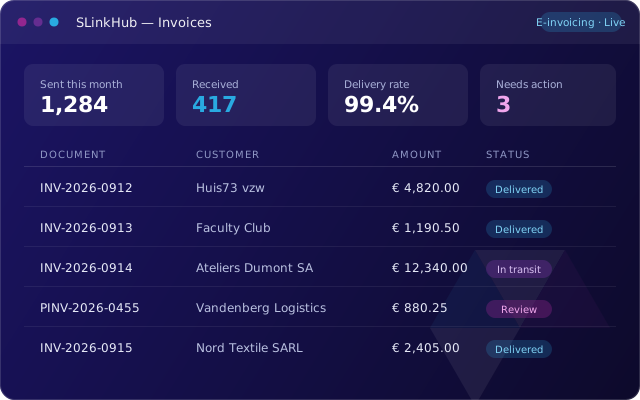
The SLinkHub invoice overview, showing outbound and inbound documents with their delivery status
Outbound and inbound documents with live delivery status, in one overview.
Dynamics interfaces

Every generation of Dynamics, one platform

Few companies run a single, current ERP. Most run what they bought, plus what they inherited through acquisition. SLinkHub was built for that reality.

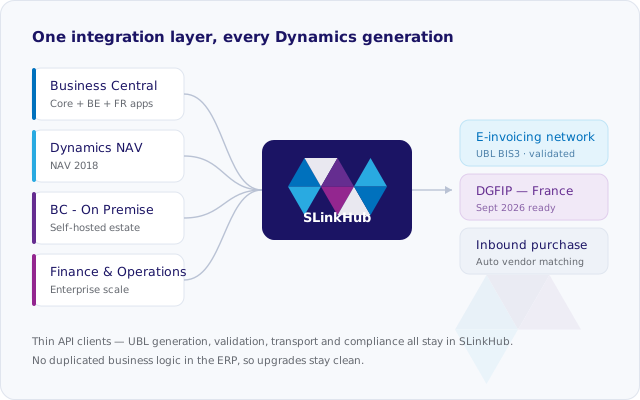
Diagram showing Business Central, Dynamics NAV, Business Central - On Premise and Finance and Operations all connecting through SLinkHub to the e-invoicing network

Business Central

Our most developed interface. A country-neutral core app plus thin country extensions — currently Belgium and France — so each customer installs core plus their own country.

🔄

Dynamics NAV

NAV 2018 environments send and receive electronically without being forced into a migration first. Compliance stops being the reason you must upgrade this year.

🏢

Business Central - On Premise

On-premises and older cloud estates that cannot move immediately still get current, validated e-invoicing through the same platform.

🌐

Finance & Operations

Enterprise-scale Dynamics 365 environments connect to the same API, so a group running mixed ERPs reports from one consistent place.

Running a mix of these across group companies is the normal case, not the exception. One SLinkHub tenant can sit behind all of them.

Capability

What the platform handles

📤

Outbound invoicing

Sales invoices are handed to SLinkHub, which generates compliant UBL, validates it against Peppol BIS3 rules and delivers it — with delivery status tracked back into the ERP.

📥

Inbound purchase invoices

Incoming documents are received and mapped into purchase documents automatically, with vendor matching, so nobody re-keys a supplier invoice by hand.

AI-assisted extraction

For the suppliers who still send a PDF, the platform extracts the data and proposes the posting, turning an inbox into structured lines.

🇲🇺

Country compliance

Country-specific rules live in country apps rather than in preprocessor flags — Belgian enterprise numbers, French SIREN and DGFIP requirements, each in their own place.

🔧

Developer API

A documented REST API with webhooks, so a custom application or a non-Dynamics system in the group can use the same e-invoicing rails.

Azure-native operations

Hosted on Microsoft Azure with environment separation between production and sandbox, and API-key authentication configured per environment.

Why it is built this way

The compliance deadline is not the hard part

Getting one invoice out electronically is a weekend. Staying compliant across several countries and several ERP generations, for years, without re-opening the ERP every time a rule changes — that is the actual problem.

  • No duplicated logic. The ERP extensions are thin clients. Nothing about UBL, validation or transport lives in your ERP, so your upgrade path stays clean.
  • Country code in country apps. One neutral core, thin country extensions subscribing to events — the same pattern Microsoft itself uses to ship localizations.
  • Sandbox before production. Environments are configured separately, so changes are proven against a sandbox before they touch live invoicing.
  • France, ahead of the date. DGFIP requirements are built in ahead of the September 2026 deadline rather than bolted on afterwards.
  • One platform, many entities. Group companies on different Dynamics generations share a single e-invoicing platform and a single view of delivery.

At a glance

Network
Peppol
Format
UBL BIS3
Hosting
Azure
Interfaces
4 Dynamics
Direction
Send & receive
Business Central Dynamics NAV BC - On Premise Finance & Operations Azure REST API
Questions

SLinkHub FAQ

No, and that is one of the main reasons it exists. There are interfaces for Dynamics NAV 2018 and Business Central - On Premise alongside current Business Central, so an older environment can meet its e-invoicing obligations without an ERP migration being forced on you by a compliance date. If you do want to modernise, that then becomes a decision you make on business grounds — see Upgrades & Migrations.

Very little, deliberately. The extension is a thin API client: it sends sales invoices out and maps received purchase invoices in. It does not generate UBL, validate against Peppol rules or handle transport — that all stays in the platform. Setup is API-key authentication configured per environment, production and sandbox separately.

Through a country-neutral core plus thin country-specific apps. Each customer installs the core and their own country app. This replaced an earlier design that used conditional compilation for Belgium and France — workable for two countries, unworkable for a third. Country rules now live in a country app instead of being compiled in, which is the same approach Microsoft uses for its own localizations.

Yes. The French extension covers SIREN identification and DGFIP requirements, built ahead of the September 2026 deadline. If you have French entities in the group, this is worth discussing early rather than in the last quarter before the date.

Yes. Underneath the ERP extensions is a documented REST API with webhooks for real-time notifications. Custom applications, a webshop, or a system in the group that is not Dynamics can use the same rails. We can also build that integration for you — see Custom Solutions.

We do — the same team that built and implemented it, under a Service Level Agreement with structured ticketing and phone access. E-invoicing is not a system you can afford to have unsupported, because a delivery failure is an unpaid invoice. See ERP Support.

See SLinkHub against your own setup

Tell us which Dynamics versions you run and which countries you invoice in. That is usually enough for us to show you exactly what your rollout would look like.